
PoE Switch Buying Guide for Kuwait Businesses (2026)
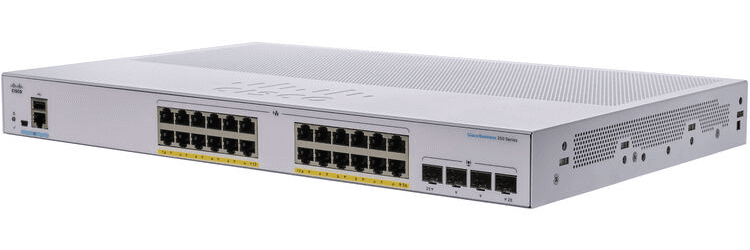
Power over Ethernet switches are the backbone of modern office networks. They power your access points, IP phones, cameras, and intercom systems through the same cable that carries data. But choosing the wrong one — wrong PoE budget, wrong port speed, wrong brand — can mean underpowered access points, cameras that reboot in summer heat, or a costly hardware swap 12 months in.
This is the buying guide we give our own customers before quoting a project.
The most important number: PoE budget
Every PoE switch has two specifications people confuse:
A 24-port PoE+ switch with 30W per port has a theoretical maximum of 720W, but the actual budget is almost always lower — typically 370W or 185W depending on the model.
Rule of thumb: Add up the PoE draw of all your devices, multiply by 1.2 for headroom, and confirm the switch budget exceeds that number.
Typical device power draws
| Device | PoE Standard | Draw |
|---|---|---|
| Basic IP phone | 802.3af (PoE) | 5–10W |
| Mid-range IP phone | 802.3af | 10–15W |
| Indoor access point | 802.3at (PoE+) | 12–18W |
| Outdoor AP (dual-radio) | 802.3at | 20–25W |
| WiFi 6/7 AP | 802.3at or 802.3bt | 22–30W |
| IP camera (standard) | 802.3af | 7–12W |
| PTZ camera | 802.3at | 15–25W |
| VoIP video phone | 802.3at | 15–20W |
Example: 20-person Kuwait office
A 24-port switch with 370W budget won't be enough. You need 440W+, or two smaller switches.
---
PoE standards explained
| Standard | Also called | Max per port | For |
|---|---|---|---|
| 802.3af | PoE | 15.4W (12.95W at device) | Basic phones, cameras |
| 802.3at | PoE+ | 30W (25.5W at device) | APs, better cameras |
| 802.3bt Type 3 | PoE++ / 4PPoE | 60W | PTZ cameras, thin clients |
| 802.3bt Type 4 | PoE++ | 100W | Digital signage, small PCs |
Most modern office deployments use PoE+ (802.3at) as the standard. Make sure your switch supports PoE+ if you're running WiFi 6 access points — many cheaper switches only support the older 802.3af standard and will underpower your APs.
---
Port speed: Gigabit vs 2.5G vs 10G
Gigabit (1G) — still the right choice for most
For IP phones, cameras, and office workstations, 1 Gbps is more than enough. A 1080p camera stream uses roughly 4–8 Mbps. A VoIP call uses under 100 Kbps. Gigabit has headroom for the next decade of normal office usage.
2.5G and multi-gig
Useful for uplinks between switches and for access points that can saturate Gigabit (high-density environments with WiFi 6/7). Not needed for most endpoint ports.
10G uplinks
Most 24–48 port access layer switches include 2–4 SFP+ ports for 10G uplinks to the core switch. Use DAC cables for short runs (under 7 metres) — much cheaper than optical.
---
Managed vs unmanaged
Unmanaged: Plug in and it works. No configuration. Fine for a small office with no VLANs, no QoS, no monitoring.
Managed: VLANs, QoS, port mirroring, SNMP monitoring, STP, port security. Required for any office with VoIP (needs QoS for call quality) or CCTV (needs VLAN isolation).
If you're reading this guide, you almost certainly need a managed switch.
Smart/Web-managed switches sit in between — VLAN and basic QoS through a web interface, cheaper than fully managed. Good for small offices (under 30 devices) that need VLANs but not OSPF or advanced ACLs.
---
Recommended models for Kuwait
Small office (up to 24 ports, under 400W budget)
Aruba Instant On 1960 24G PoE — 195W budget, 24x1G PoE+, 2x10G SFP+ uplinks. Clean web management, solid build quality, 3-year warranty. ~280–350 KD.
TP-Link TL-SG2428P — 24-port PoE+, 250W budget, affordable. Good for tight budgets. ~120–150 KD.
Medium office (24–48 ports, 400W+ budget)
Aruba 1930 48G PoE — 48x1G PoE+, 370W budget, 4x10G SFP+ uplinks. Solid mid-range choice. ~500–650 KD.
Cisco CBS350-48P — 48-port PoE+, 740W budget (high-power model). Full managed, Cisco support. ~700–900 KD.
High density / enterprise (large PoE budget, 10G access)
Cisco CBS350-48FP — 48-port full PoE (740W), 4x10G SFP+. One of the highest-budget access switches in its class. ~900–1,200 KD.
Aruba 2930F 48G PoE+ — Enterprise class, stackable, 740W. For multi-floor office deployments. ~1,200–1,500 KD.
---
Kuwait-specific considerations
Heat: Kuwait summers push ambient temperatures in telecom rooms above 40°C if AC fails for even a few hours. Switches with operating temperature ratings above 50°C and passive/efficient cooling age better here. Don't stack switches in an enclosed cabinet without airflow.
Dust: Patch panels and switch ports in buildings without proper positive-pressure airflow accumulate dust. A switch with port covers for unused ports, or one you check annually, will outlast one left open in a dusty comms room.
Humidity: Generally not a concern in Kuwait offices, but outdoor or semi-outdoor installations (car parks, loading docks) need IP-rated switches. Look for IP30 or higher.
---
Checklist before you buy
---
How to order
Browse the full switch range on Centrix or contact us with your device list and floor plan. We'll give you a free equipment recommendation and quote within 24 hours.